
Ozzy Osbourne: The Voice That Changed Rock Forever

For any millennial who grew up anywhere near rock culture—whether in a bedroom filled with posters, a college hostel buzzing with distorted guitars, or late-night radio shows crackling through cheap speakers—it is impossible not to have heard that voice. A voice that did not shout, did not roar, but haunted. A voice that sounded nasal, eerie, thin yet piercing. A voice that floated like a ghost above crushing guitar riffs. That voice belonged to one man—Ozzy Osbourne.
Ozzy Osbourne did not sound like a trained metal singer. And that was precisely the point. His voice was raw, unpolished, deeply human. It carried vulnerability rather than bravado, fear rather than fury. Instead of overpowering the music, his vocals hovered eerily over Tony Iommi’s massive riffs, creating a tension that felt unsettling and hypnotic. Technically, he sat somewhere between a high baritone and a low tenor—not a classic metal screamer, not a deep-throated baritone either. His range lived in a nasal, mid-to-high register that sliced cleanly through loud guitars and dense arrangements.
Ozzy’s voice was distinctly reedy and nasal, giving it a haunting character that stood out instantly. It was not thick or powerfully belted, but thin and piercing, capable of cutting through walls of sound. There was an unmistakable plaintive quality to his delivery—mournful, ghostly, sometimes ominous. His singing carried a straight tone, with minimal vibrato, unlike blues or classic rock vocalists. Add to that a slight slur and drag on sustained notes, and you had a vocal style that no one could imitate without sounding artificial. It was fragile, hypnotic, and deeply unsettling.
In many ways, Ozzy did not just help create heavy metal—he gave it an emotional language. His music felt doom-laden and melancholic rather than aggressive. Vulnerable rather than macho. And paradoxically, that vulnerability made it darker.
John Michael Osbourne, born on 3rd December 1948, Ozzy would go on to become one of the most influential figures in rock history. Widely known as the “Prince of Darkness,” he was a singer, songwriter, performer, and cultural phenomenon whose career stretched across more than five decades. When he passed away on 22nd July 2025, just days after his final stage appearance, the world did not just lose a musician—it lost an era.
Ozzy first rose to prominence as the co-founder and lead vocalist of Black Sabbath, formed in Birmingham in 1968. Alongside guitarist Tony Iommi, bassist Geezer Butler, and drummer Bill Ward, he helped invent a darker, heavier form of rock music that had never been heard before. Albums like Black Sabbath and Paranoid in 1970, followed by Master of Reality in 1971, changed the musical landscape forever. These records laid the foundation for heavy metal, influencing generations of artists across the globe.
The band’s dark direction was inspired by a simple observation—that people were drawn to fear and suspense, just like they were to horror films. Black Sabbath leaned into that darkness, pairing ominous lyrics with heavy, blues-based riffs. While early critics were divided, audiences responded instantly. Songs like “Iron Man,” “War Pigs,” and “Paranoid” became anthems, and albums such as Vol. 4, Sabbath Bloody Sabbath, and Sabotage later earned classic status.
But success came at a cost. Endless touring, fame, and substance abuse took a severe toll. By the late 1970s, tensions within the band had reached breaking point. Ozzy briefly left to explore solo ideas, returned for Never Say Die!, and then, in 1979, was dismissed from Black Sabbath amid growing concerns about reliability and health. For many artists, that would have been the end.
For Ozzy Osbourne, it was a rebirth.
In the early 1980s, under the management of Sharon Arden, who would later become his wife, Ozzy launched a solo career that stunned critics and fans alike. Teaming up with the brilliant young guitarist Randy Rhoads, he released Blizzard of Ozz in 1980 and Diary of a Madman in 1981. These albums were not just successful—they were transformative. Songs like “Crazy Train” and “Mr. Crowley” introduced Ozzy to a new generation and cemented his place as a solo force in heavy metal.
Tragedy struck in 1982 when Randy Rhoads was killed in a plane crash while on tour. The loss devastated Ozzy and temporarily halted his momentum. Yet, even through grief, controversy, and addiction, he continued. The 1980s saw Ozzy become one of rock’s most infamous figures, known as much for outrageous incidents as for his music. From shocking stage antics to public backlash over perceived satanic imagery, he remained at the centre of controversy. Still, his popularity only grew.
Albums like No Rest for the Wicked and No More Tears in the late ’80s and early ’90s revealed a more reflective side. Tracks such as “Mama, I’m Coming Home” showed emotional depth, while his collaborations expanded his musical reach. Slowly, relationships with former Black Sabbath bandmates began to heal.
The late 1990s marked a turning point. In 1997, Black Sabbath reunited onstage during Ozzfest, a touring festival created by Sharon Osbourne after Ozzy was rejected by Lollapalooza. What began as a response to exclusion became a cultural juggernaut. Ozzfest gave a platform to emerging metal bands and reshaped the live music scene. Millions attended worldwide, and the festival became a defining force in metal culture.
That same year, Ozzy released The Ozzman Cometh, reaffirming his relevance. In 1998, Black Sabbath released Reunion, followed by a massive tour that ran into 1999. Though tensions resurfaced at times, the legacy was secure.
In the early 2000s, Ozzy entered an entirely new phase of fame through the MTV reality series The Osbournes. The show transformed him into a mainstream celebrity, revealing a confused, funny, often endearing family man far removed from the “Prince of Darkness” image. It pioneered celebrity family reality television and introduced Ozzy to audiences who had never heard a Black Sabbath record.
Health challenges became more prominent after a serious quad-bike accident in 2003. Yet, even then, Ozzy surprised everyone by achieving his first UK number-one single in 2004 with “Changes,” a duet with his daughter Kelly. He continued recording, touring, and appearing in mainstream media, including judging The X Factor and releasing introspective albums like Black Rain.
A full Black Sabbath reunion in 2012 led to the album 13, which topped charts worldwide. Their farewell tour, The End, concluded in Birmingham in 2017, closing the Sabbath chapter where it began.
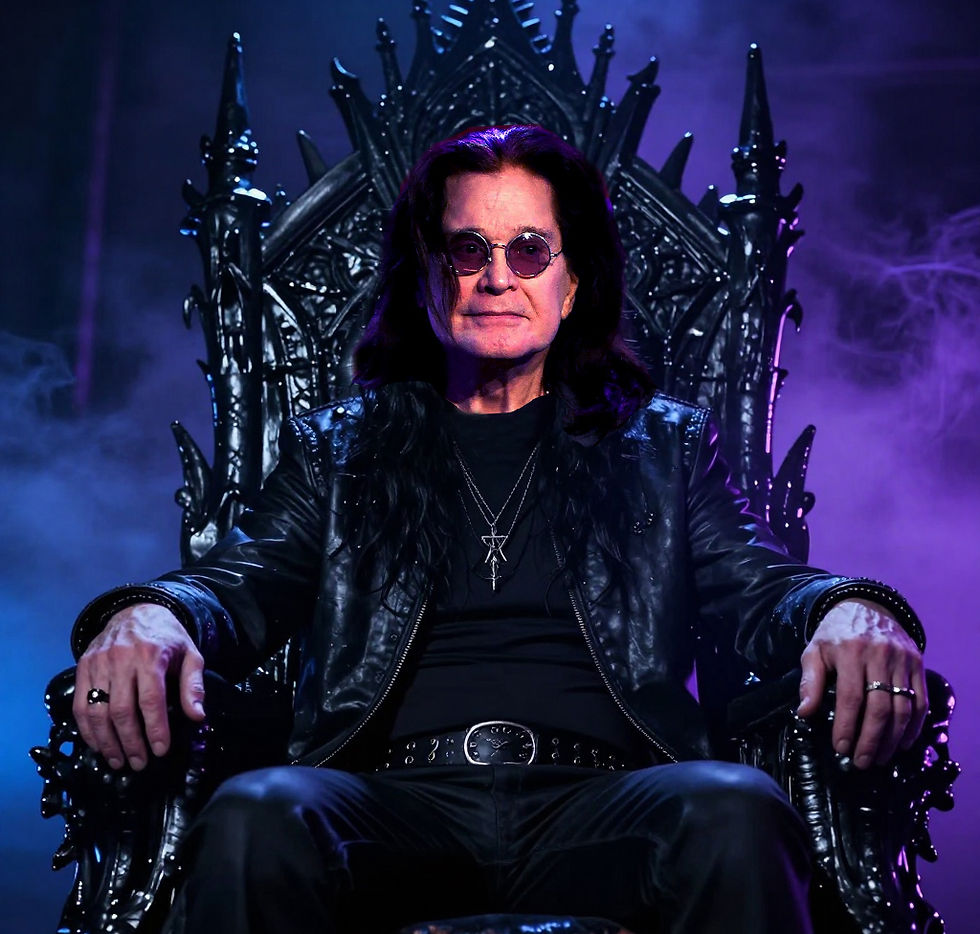
Even as Parkinson’s disease and spinal injuries limited his mobility, Ozzy never stopped creating. Albums like Ordinary Man and Patient Number 9 proved his relevance well into his seventies. In July 2025, he delivered his final performance at Villa Park in Birmingham, seated on a throne, singing through pain and illness. The concert, titled Back to the Beginning, was watched by millions and ended with all proceeds donated to charity.
Seventeen days later, Ozzy Osbourne passed away at his Buckinghamshire home, aged 76, surrounded by family. Tributes poured in from across the world. Elton John called him a dear friend and a true trailblazer.
His funeral procession through Birmingham drew tens of thousands. His music echoed even at Buckingham Palace, where “Paranoid” was performed during the Changing of the Guard. He was laid to rest beside a lake on his family estate, as he wished.
Ozzy Osbourne’s legacy is monumental. A founding architect of heavy metal. A voice that sounded fragile yet terrifying. A man who lived through chaos and creativity in equal measure. He once said his music was simply rock. But the world knows better.
Long after the amplifiers fall silent, Ozzy Osbourne’s voice will still haunt the airwaves—thin, eerie, hypnotic, and eternal.


Comments